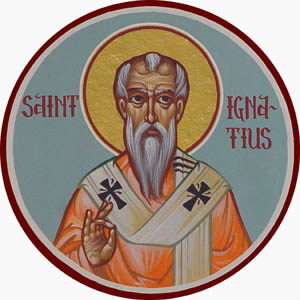
INTRODUCTION
The significance of these seven letters lies in their being intimate, familiar, and popular. They do not, in the first instance, reveal a set of ideas though they are not lacking in thoughtfulness. Rather do they reveal a man. So much of early Christian literature is impersonal that it is refreshing to stumble upon letters reminiscent of the frank and personal note of Paul's correspondence. The conditions under which Ignatius’ letters were written did not make for careful reflection. They are the letters of a prisoner on his way to martyrdom. Their religious character is popular rather than deep. Their style is compressed and turbulent, reflecting the brusque and impetuous nature of their author (Trall., ch. 4), as well as the irritation of a captive subjected to brutality (Rom. 5:1). Their metaphors change with alarming abruptness, and are often more striking than apt (Eph., ch. 9). Their grammar is not free from carelessness. Yet for these very reasons they have a peculiar value. They disclose a real person, expressing himself in the moment of crisis, and so making clear the ruling passions of his life.
Our knowledge of Ignatius is confined almost entirely to these letters. The later acts of his martyrdom are pure romances, resting on no historical foundations. It is only for the few days when he journeys from Philadelphia to Troas under a military guard that we catch a glimpse of this early second century bishop.
It appears that he was bishop of Antioch in Syria, and during a short but intense persecution of that city had been condemned to fight with wild beasts in Rome. Perhaps others had suffered the same fate, but this is not altogether clear unless we so interpret the reference in Rom., ch. 10. In any case, chained to a squad of soldiers, he is taken by the overland route through Cilicia and Asia Minor, and thence to Rome. Where the way forks at Laodicea, the northern road is chosen. He halts at Philadelphia, and then again at Smyrna, where he is welcomed by Polycarp, the bishop of that city, and by delegates from the neighboring churches of Ephesus, Magnesia, and Tralles. It is from Smyrna too that he writes the first four of his letters—three to the churches that had sent delegates and one to the church at Rome. Pressing northward, he stops again at Troas. From here he corresponds with the churches of Philadelphia and Smyrna, and adds a personal note to Polycarp. We gather that he crossed by sea to Neapolis and halted once more at Philippi, where the Christians welcomed him.164 After that he passes out of sight. We may, however, conjecture that he reached Italy by way of Dyrrhacium and Brundisium. Furthermore, we may be fairly sure that he was eventually martyred in the Coliseum sometime during Trajan's reign (A.D. 98–117).
Ignatius’ letters are dominated by three concerns. First is his approaching martyrdom. To "imitate the Passion of my God" (Rom. 6:3) is the exclusive theme of the letter to the Romans, but it underlies the others as well. This, for him, is the way to become a "real disciple," a "genuine Christian." He is clearly impatient to "get to God"166 by way of martyrdom; and to brace himself for the ordeal he pictures in startling detail what this must mean for him (Rom. 5:2, 3). We are not, therefore, surprised that the same line of thought is reflected in other aspects of the letters. His theology, for instance, revolves around the blood of Christ (cf. the striking and compressed thought of Eph. 1:1); and he emphasizes the reality of Christ's Passion by pointing to his own imminent death (Smyr. 4:2).
The second concern is for the unity of the Church. Against threatening schisms, Ignatius is persistent in his stress on obedience to the Church authorities. In his letters there first emerges the picture of the local congregation governed by a single bishop who is supported by a council of presbyters and assisted by deacons. In this Ignatius betrays a stage of development beyond the situation reflected in the Pastoral Epistles, the Didache, and I Clement. There the titles "bishop" and "presbyter," and perhaps the offices too, are not clearly distinguished. The local congregations are ruled by boards of officials (sometimes called bishops, sometimes presbyters), subject only to apostolic figures, such as Timothy and Titus, or to itinerant prophets. In Ignatius, on the contrary, the single bishop is the leading figure in the Church. Without his approval no services are to be held (Smyr. 8:2) or other action taken (Trall. 7:2). He seems to represent the localizing of the teaching, ruling, and prophetic functions of the original missionary ministry of apostles, prophets, and catechists. This process had, indeed, already started in the Didache (see ch. 13); but in Ignatius it is complete.
What, however, is most striking about this appearance of the monepiscopate in Ignatius is the lack of an explicit doctrine of apostolical succession. For him the authority of the Church officers is not derived from a chain of teaching chairs (as in Irenaeus) or from a succession of ordinations (as in Augustine), but from the fact that their offices are the earthly antitype of a heavenly pattern. The bishop, for instance, represents God; the presbyters, the apostles; and the deacons, Christ (Mag. 6:1). Such teaching stems from a Platonic way of looking at things, and stands in marked contrast with those views of authority that emphasize the historical connection between the episcopate and the apostles. Rather is it a mystical nexus between the earthly Church and the sphere of the divine, which is fundamental in Ignatius. It is this that makes it possible for him to urge that deference to the bishop is the same thing as deference to God (Eph. 5:3–6).
The bishop in Ignatius, moreover, is not only an administrative and liturgical officer. He is also a prophet. This is especially true in his own case. In Philad., ch. 7, he gives us an instance of his gifts in this direction, while the name Theophorus ("God-inspired"), which he assumes, is likely not a proper name but an epithet to indicate his prophetic character. One may note, similarly, how he urges Polycarp to seek for heavenly revelations (Poly. 2:2). Not inappropriately, therefore, did the Smyrnaeans remember Polycarp as "an apostolic and prophetic teacher" (Mart. Poly. 16:2).
The third concern in Ignatius is to unmask those heretical movements which are leading to schism. Two of these are prevalent; and while he does not go into detail, believing as he does more in order than in argument, we may gather their main features from his casual references.
In Philadelphia he came into personal contact with a Judaizing movement similar to the one attacked by Paul in his Letter to the Galatians and mentioned later in the Apocalypse (ch. 3:9). It was, to be sure, not so thoroughgoing as that faced by Paul, circumcision not being demanded of its Gentile devotees (Philad. 6:1). But the observance of the Sabbath was involved, along with belief in certain Jewish traditions and allegories (Mag., chs. 8; 9).
At the opposite pole to this error was the Docetic heresy, rife in Smyrna. Here the attempt to accommodate the gospel to Greek culture had gone to the limit of denying the reality of the Lord's body. The basic Hellenistic idea that matter was evil led inevitably to disbelief in the incarnation. God could not have a direct relation with the sensible world, since this was the province of evil. Accordingly, Christ could not have been genuinely man. He only appeared or seemed to have a body (whence "Docetism," from the Greek doke , seem), being as it were a phantom from the heavenly sphere. The way Ignatius plays on this theme is interesting. By inventing a sham Christ (a Christ who only "seems" to be), the Docetics prove themselves to be a sham, and they will end up by becoming apparitions! (Trall., ch. 10; Smyr., ch. 2).
Against such views Ignatius introduces two of the leading emphases of his theology. One is the divinity of Christ. This was compromised by the Judaizing movement, which viewed him as the last of the prophets. For Ignatius, Christ is "our God." He can even speak of the "Christ God" (Smyr. 10:1), revealing by such an expression his own Christocentric faith and also something of the liberal use of the word theos (god) to be found in Hellenistic circles.
The other emphasis of Ignatius’ Christianity falls upon the reality of the incarnation, Passion, and resurrection of the Christ. He continually stresses the genuine and actual nature of these occurrences and the inseparable unity of flesh and spirit—even after the resurrection (Smyr., ch. 3). So much so, that such repeated phrases as "in flesh and in spirit" become expressions similar to our "body and soul," and are used as synonyms for "thoroughly" or "completely" (cf. Eph. 10:3; Mag. 13:2).
While these are two of the central themes of Ignatius' thought, recent study has drawn attention to other aspects of it. One concerns the affinities between Ignatius and the Gnostics. There are, indeed, traces of Gnostic terminology in the letters, and a number of ideas (as for instance those in Eph., chs. 19; 20) which were later elaborated in the Valentinian and other systems. But Ignatius was not a Gnostic: he was very far from it. His was not a speculative mind. Indeed, it is the simplicity and uncompromising quality of his basic convictions, so frequently expressed in compact, credal statements, which are most characteristic of him. That is not, however, to deny that Ignatius is hospitable to quite a few phrases and ideas familiar from Hellenistic religion and alien to the general stream of Biblical thought. The Eucharist is "the medicine of immortality" (Eph. 20:2); Christians are "full of God" (Mag., ch. 14); God is Sig (silence, Mag. 8:2); and the divine sphere is Pl r ma (fullness, Eph., inscr.). Again, Ignatius alludes to the myth of the New Man (Eph. 20:1), and has touches of Gnostic influence in his Church mysticism, where the earthly order reflects the heavenly pattern. Yet, for all that, the central convictions of the Christian faith are clearly—even dogmatically—affirmed, while against the basic Gnostic tenet that matter is evil he wages a constant warfare.
Closely connected with this issue are others which bear upon Ignatius’ relation to the New Testament faith. How far does he deviate from the Pauline gospel? Is he influenced by John? Does he depart from John? It is not needful here to review these complex questions at length. Rather should the reader bear them in mind as he surveys the letters. One or two points, however, may be noted.
Ignatius knew several letters of Paul —perhaps the original corpus of seven. He was most familiar with I Corinthians. He probably knew Ephesians; and there may be reminiscences of others. Some parts of the Pauline gospel—above all, the sense of fellowship with the crucified and risen Christ—he understood well. Others were strange to him. He never grasped Paul's teaching on justification, on deliverance from sarx (flesh), or on the indwelling Spirit. Nor did he penetrate the fullness of Paul's view of faith as receptivity, the opposite of boasting. In Ignatius faith is primarily conviction. Sometimes, indeed, he uses Pauline phrases with meanings that widely differ from the original (e.g., Rom. 5:1; Eph. 8:2).
With John the question is more difficult. There are a number of possible reminiscences (Mag. 7:1; Rom. 7:2, 3; Philad. 7:1; 9:1), but none is decisive. All of them can be explained by a common religious ethos. Yet their weight is cumulative, and there is a close relation between the views of John and Ignatius on the Eucharist (cf. John 6:54 with Eph. 20:2, and Smyr. 7:1).
In general it would be true to say that the Christianity of Ignatius represents a step removed from the central New Testament faith. It lacks the freshness and depth of the Pauline and Johannine gospels, though this can easily be exaggerated. The process by which the faith became ordered and organized, thereby losing something of its original spontaneity and reliance on the Spirit, is evident in the New Testament itself, especially in the Pastoral Epistles. Ignatius carries the development a little farther, striking out on a line of Church mysticism somewhat different from the moral note of the Pastorals and I Clement. But at the same time it is impossible to miss in Ignatius the intense devotion to the person of Christ and the consciousness of fellowship with his sufferings.
"A soul seething with the divine eros"—such is Chrysostom's description of Ignatius in his eulogy delivered on the martyr's feast in Antioch.167 It is an apt phrase, for more reasons than Chrysostom intended. There is a religious vehemence about these letters, even an impatience and a heat of excitement, which is more fittingly expressed by the classical eros than by the uniquely Christian agap . Ignatius is himself aware of his lack of gentleness and calm (Trall. 4:2). He had, too, something of those sharp alternations of pride and humility, which we meet in Paul (Trall., chs. 4; 5). His letter to the Romans, moreover, expresses that exaggerated passion for martyrdom which the Church later sought to restrain. In the light of these traits it is interesting to notice how struck Ignatius was by the bishops of Ephesus and Philadelphia (Eph., ch. 6; Philad. 1:1). He saw in their modest and retiring character what was most lacking in his own. By their quietness they seemed the more effectual and, as bishops, were the better able to mirror the divine nature which their office represented (Eph., chs. 6; 15). God's essential character was that of silence—a silence broken only at the incarnation, and even then with reserve and modesty (Eph., ch. 19).
Yet, for all this, there is a nobility about this Oriental martyr. He can recognize his weakness, and he has grasped the central truth of the Christian gospel, incorporating it into his very life. He will suffer with Christ and so become a genuine disciple.
MANUSCRIPTS AND BOOKS
The letters of Ignatius were first collected by Polycarp, the bishop of Smyrna,168 who sent copies of them to the church at Philippi not long after Ignatius had left that city on his way across Macedonia (Phil., ch. 13). Whether this collection contained all seven letters is not clear. Possibly Polycarp did not have access to the one to the Romans, though this was early in circulation, being quoted by Irenaeus (Adv. haer. V. 28:4), and known, of course, to Eusebius. It is likely that copies of all the letters were kept by Ignatius’ amanuensis, the Ephesian Burrhus (see Philad. 11:2), and that Polycarp obtained them from him.
We possess no pure manuscript of the original corpus, for in the fourth century the letters were interpolated and six additional ones added (Mary of Cassobola to Ignatius; Ignatius to Mary, to the Tarsians, Philippians, Antiochenes, and to Hero, deacon of Antioch). The aim of these forgeries was to gain for a diluted form of Arianism the authority of a primitive martyr. Finally, in the Middle Ages—perhaps around the twelfth century, which saw a new development of the cult of the Virgin—a correspondence between Ignatius and Mary, as well as two letters of Ignatius to John, was fabricated in the West.
The greater part of the extant manuscripts contains the seven interpolated letters along with five or six of the spurious ones, some of the Latin versions adding the medieval forgeries. The first edition of the Latin was by J. Faber Stapulensis (Lefèvre d’Étaples), Paris, 1498, and of the Greek by Valentinus Paceas, Dillingae, 1557.
With the revival of learning in the Renaissance a critical spirit toward the Ignatian corpus first arose; but it was not until the labors of Theodor Zahn and J. B. Lightfoot in the nineteenth century that the question was finally settled and the genuine form of the letters of Ignatius was fully established.
A pioneer work which attempted to separate the wheat from the chaff was that of the Genevan professor Nicholaus Vedelius in 1623. He printed the seven letters known to Eusebius by themselves, relegating the six spurious ones to a separate volume. He recognized, too, that even the seven genuine ones had been interpolated. It was, however, Archbishop James Ussher who in the seventeenth century first discovered the pure text of the letters, though in a Latin version. The controversy with the Puritans over episcopacy brought the question of the genuineness of Ignatius’ correspondence into the foreground; and, in his efforts to defend this, Ussher came upon two Latin manuscripts that contained versions of the text corresponding to that known to Eusebius and other fathers. These manuscripts did, indeed, contain five of the forged letters as well; but the remarkable thing was that the text of the genuine seven had not been interpolated. Ussher published his text in 1644, and his guess that Robert Grosseteste (the learned medieval bishop of Lincoln) had been the translator has since been confirmed.
Two years later (1646) Isaac Voss in Amsterdam published the Greek text of this Latin version from an eleventh century Florentine manuscript. In this the letter to the Romans is wanting, the manuscript being defective and breaking off in the middle of the Epistle to the Tarsians. But as it was customary to separate Romans from the others and to embed it in the Acts of Ignatius’ Martyrdom, it was doubtless in the original manuscript. These Acts would have come at the end, as they do in Ussher's Latin versions. Anyway, the defect was supplied by the discovery of a tenth century Greek manuscript of the Martyrology, published by T. Ruinart in 1689.
The authenticity of the text defended by Ussher and Voss was soon attacked by French Calvinists (notably by Jean Daillé in Geneva, 1666); but a full and learned reply was offered by Bishop John Pearson in his Vindiciae Ignatianae, 1672.
Considerably later (1845) an English canon, Dr. W. Cureton, published a Syriac version of three of the letters (Polycarp, Ephesians, and Romans). This text (based finally on three manuscripts) was considerably more brief than the Vossian; and in his learned work Corpus Ignatianum (1849) Cureton argued that it represented the genuine form of the letters. His theory, however, did not win acceptance. The works of Theodor Zahn (Ignatius von Antiochien, Gotha, 1873) and of J. B. Lightfoot (The Apostolic Fathers, Part 2, Vol. I, London, 1885) have convincingly shown that Cureton's text represents a rather crude abridgment of the original letters.
To summarize: the letters of Ignatius have come down to us in three forms. There is the long recension, interpolated in the fourth century. There is the short Syriac recension, which is an abridgment of the authentic letters. Finally there is the middle recension, or genuine text. A full description of the manuscripts (including the Armenian, and the Syriac and Coptic fragments) will be found in Lightfoot, op. cit., pp. 70–126; 587–598. To this must be added the fifth century Berlin papyrus fragment of Smyrnaeans (in Greek: see C. Schmidt and W. Schubert in Altchristliche Texte, Berliner Klassikertexte, Heft VI, 1910), and the Coptic fragments published by Carl Wessely in Sitzungsberichte der kais. Akademie der Wissenschaften in Wien, Vol. CLXXII, Part 4, 1913.
THE ACTS OF IGNATIUS' MARTYRDOM
The Acts of Ignatius’ Martyrdom are current in five forms. Of these only two are independent, the so-called Antiochene and Roman Acts. The others are combinations and modifications of them. The Antiochene Acts derive their name from the fact that their center of interest is Antioch, where Ignatius is tried by Trajan and whither his bones are brought back from Rome. These Acts date from the fifth century and rest on no historical foundation. Their textual history, however, is important, since the genuine text of Ignatius’ Letter to the Romans is embedded in them. They are current in Latin, Greek, and Syriac.
Even more crudely legendary are the Roman Acts, which belong to the sixth century and record Ignatius’ trial before Trajan and the Senate and his martyrdom in the amphitheater. They are extant in Greek and Coptic.
TEXTS AND STUDIES
The best Greek text, and the one used for this translation, is by Karl Bihlmeyer in his revision of F.X. Funk's Die apostolischen Väter, Part I, Tübingen, 1924. More recent, but based on this, is P. Th. Camelot's Ignace d’Antioche, Lettres, Éditions du Cerf, Paris, 1944 (in the series Sources chrétiennes, with translation). Kirsopp Lake did the text with translation for the Loeb Classics, The Apostolic Fathers, London, 1912. Lightfoot's text and translation is in Part 2, Vol. II, of his Apostolic Fathers, revised ed., London, 1889.
The more important translations are as follows: by Lake and Lightfoot in the editions mentioned; by J. H. Srawley, The Epistles of St. Ignatius, Bishop of Antioch, London, 1919; by J. A. Kleist, The Epistles of St. Clement of Rome and St. Ignatius of Antioch, Newman Press, Westminster, Maryland, 1946, in the series Ancient Christian Writers; by Gerald G. Walsh, The Apostolic Fathers, Fathers of the Church Press, New York, 1946, in the series The Fathers of the Church. The last two versions bring out Ignatius’ meaning in modern, idiomatic English. The Letter to the Trallians has been characteristically rendered by James Moffatt in an article in the Harvard Theological Review, 29, 1936, pp. 1–38, "An Approach to Ignatius." The latest English translation (exact and pointed, but not bold) is by Edgar Goodspeed in The Apostolic Fathers: An American Translation, Harper & Brothers, New York, 1950.
The best French translation, incisive and idiomatic, is by Auguste Lelong in Hemmer and Lejay, Les Pères apostoliques, Vol. III, Paris, 2d ed. 1927. In addition there are the more literal renderings of Camelot (already mentioned) and H. Delafosse in his Les Lettres d’Ignace d’Antioche, Paris, 1927 (where he adduces a radical theory of their late date and fictitious character). In German there are these versions: by Walter Bauer, Die Briefe des Ignatius von Antiochien, in the series Handbuch zum N.T., Tübingen, 1920; by G. Krüger in Hennecke, Neutestamentliche Apokryphen, 2d ed., J. C. B. Mohr; Tübingen, 1924; and by F. Zeller, Die apostolischen Väter, in the 2d series of the Bibliothek der Kirchenväter, Munich, 1918.
In Italian there is I Padri apostolici, Part 2a, by G. Bosio, Vol. XIV, in the series Corona Patrum Salesiana, Turin, 1942.
All these editions have introductions and notes, the most valuable being those of Lightfoot, Srawley, Kleist, and Bauer.
In addition to the works of Zahn and Lightfoot previously mentioned, the following are the
more important recent studies in Ignatius:
E. von der Goltz, Ignatius von Antiochien als Christ und
Theologe (a fundamental work) in Texte und Untersuchungen, Vol. XII, Part 3, Leipzig, 1894;
M.
Rackl, Die Christologie des heiligen Ignatius von Antiochien (rich in bibliography) in Freiburger
theologische Studien, 14, 1914;
H. Schlier, Religionsgeschichtliche Untersuchungen zu den
Ignatiusbriefen (a valuable study but one that exaggerates Ignatius’ dependence on Gnostic and
"mystery" sources), A. Töpelmann, Giessen, 1929;
H. W. Bartsch, Gnostisches Gut und
Gemeindetradition bei Ignatius von Antiochien (which further pursues the Gnostic theme), C.
Bertelsmann, Gütersloh, 1940;
C. C. Richardson, The Christianity of Ignatius of Antioch (a survey
of main concepts), Columbia University Press, New York, 1935, and "The Church in Ignatius of
Antioch" in The Journal of Religion, 17, pp. 428–443, 1937;
F. A. Schilling, The Mysticism of
Ignatius of Antioch, Thesis, University of Pennsylvania, Philadelphia, 1932;
E. Bruston, Ignace
d’Antioche, ses epîtres, sa vie, sa théogie, Paris, 1897;
H. de Genouillac, L’Église chrétienne au
temps de Saint Ignace d’Antioche, Paris, 1907.
The trinitarian question has been studied by Jules Lebreton in his article "La Théologie de la Trinité d’après Saint Ignace d’Antioche" in Recherches de science religieuse, 15, pp. 97–126, 393–419, 1925, and in his Histoire du dogme de la Trinité, Vol. II, pp. 282–331, Paris, 1928. James Moffatt has characterized Ignatius’ faith in "A Study in Personal Religion" in The Journal of Religion, 10, pp. 169–186, 1930, an essay which is supplemented by his article in the Harvard Theological Review, January, 1936, already cited. The connection between Ignatius and John has been investigated by P. Dietze, "Die Briefe des Ignatius von Antiochien und das Johannesevangelium" in Studien und Kritiken, 78, pp. 563–603, 1905; by W. J. Burghardt in Theological Studies, 1, pp. 1–26, 140–156, 1940; and more recently by C. Maurer in his Ignatius von Antiochien und das Johannesevangelium, Zurich, 1949. This last study, along with the chapters on Ignatius in J. Klevinghaus, Die theologische Stellung der apostolischen Väter zur alttestamentlichen Offenbarung, C. Bertelsmann, Gütersloh, 1948, and in T. F. Torrance, The Doctrine of Grace in the Apostolic Fathers, Oliver, Ltd., Edinburgh, 1948, represents a modern Protestant tendency to emphasize the decline of the New Testament faith in the post-Apostolic period, without fully appreciating the connection between the New Testament and the subapostolic writers. Finally mention may be made of Th. Preiss's article "La Mystique de l’imitation du Christ et de l’unité chez Ignace d’Antioche" in Revue d’histoire et de philosophie religieuses, 18, pp. 197–241, 1938; of M. H. Shepherd's essay "Smyrna in the Ignatian Letters" in The Journal of Religion, 20, pp. 141–159, 1940; and of the note by Henry Chadwick, "The Silence of Bishops in Ignatius," in the Harvard Theological Review, April, 1950, pp. 169–172.