We come now to consider Ignatius the second in our list of heroes of the early Church.
About the exact time and place of the birth of Ignatius, and his parentage, we have no certain knowledge, and therefore on these points we shall not attempt to say anything. Only this remark may be made: that if the statement is correct which represents him to have been about eighty years of age when he died, and If that event took place in the year 116 or 117, then he must have been born between the years 30 and 40 of the Christian era.
Ignatius always used to speak of himself as Ignatius Theophoi^its. This is a Greek word which means being borne or carried by God. And every one who is trying to be a true Christian may well be thus spoken of. For we are clearly taught in the Bible that God's everlasting arms are under all his followers, and his sheltering wings are over them.
It has been reported that Ignatius was the very child that our Saviour took up In his arms when he wished to teach his disciples the great lesson that they must be converted and become as little children if they wished to be his true followers. It would be an Interesting circumstance in the history of this good man if we could know that this w^as a fact; but this cannot be known, and so we merely refer to the circumstance and pass it by.
Ignatius in his earlier years had the privilege of receiving instruction from the apostles Peter and Paul. He not only heard them preach In public, but was also favored with their more familiar teachlnofs In private. While thus Intimate with the apostles just mentioned, he tells us himself, that he was the disciple of the apostle John. Under the instruction of these great and good men he was taught " the truth as it is in Jesus"; and then, in view of the thorough knowledge he had of the gospel, as well as of his great piety and the excellent gifts which God had bestowed upon him, he was chosen by the apostles to be the head and ruler of the church in the city of Antioch. This is a city which has had a very interesting and important history. It was founded about three hundred years before Christ, and is situated on the river Orontes, sixteen miles from the Mediterranean Sea. It stands on a beautiful plain surrounded by ranges of mountains. The temples and palaces of Antioch were of the very finest kind. A wide avenue ran through the centre of the city, about four miles long, on either side of which was a covered way supported by marble columns. Antioch was one of the most famous cities of the East. The rulers and great men of Syria made it their headquarters. It was at the height of its prosperity in the days of Ignatius, and we are told that it then had a population of four hundred thousand inhabitants. One of the things of greatest interest to us In the history of this city is that the disciples of our blessed Lord "were first called Christians at Antioch."
It has been nearly destroyed a number of times by earthquakes, and is now only a small city, with a population of not over ten thousand.
But this famous city was the scene of the labors of Ignatius for about forty years ; and in the studying of the history of this good man's life, we find illustrations of four lessons which it is very important for us all to learn.
1. The lesson of practical wisdom. To know just what to do and how to do it, is the grand secret of success in all our lifework. This secret Ignatius posessed. The times in which he lived were times of persecution, trial, and difficulty. His position, at the head of the church at Antioch, was like that of a pilot steering his vessel through a dangerous channel, where rocks on one hand and shoals on the other are constantly presenting the danger of shipwreck. When false teachers were engaged in efforts to spread abroad erroneous doctrines, he sought in every way to guard his people against these dangers by simple, earnest and untiring statements of the truth as God had revealed it in his word. Thus the members of his church were preserved from the dangers to which they were exposed, and were helped to cling faithfully to the truths of the gospel in spite of the errors that were then prevailing. And when the days of persecution came upon the church, he was untiring in his efforts to strengthen those who were weak, to encourage those who were depressed, to point them all to that Almighty Arm on which they were permitted to lean, and to tell them of that omnipotent grace which would be sufficent for them in every time of need, and would bring them off at last more than conquerors through him who had loved them and given himself for them.
And when we think how successful this hero of the early Church was in finding out just what he ought to do amidst the perplexities that attended his path, and in securing the help and guidance which enabled him for so many years to do all that his important and responsible position made It his duty to do, we may learn a useful lesson for ourselves ; for the same wisdom which guided him to see what he ought to do, and the same grace which enabled him to do it. Is just what we need, and just what God will give us if we seek it from him, as Ignatius did.
2. The life of this good man teaches us the lesson of patient endurance. Trajan, the Roman emperor, visited Antloch early in the second century of the Christian era. He had just gained a great victory over the Scythians and the Daclans, and was preparing for a war with the Parthlans and the Armenians. He entered the city with great pomp and parade. One of his armies had been defeated by the Christians in another part of his empire. This made him very angry. He began to persecute the Christians in different places ; and while staying In Antloch, he made special Inquiries about what the Christians there were doing. Ignatius thought it best to call on the emperor and converse with him on this subject. They talked freely about the different religions of the world. Ignatius was honest and faithful in what he said. He told the emperor what the Christian reliction was and where it came from. He said there was but one true God, and that is the God whom the Christians worship. He declared that the Christian religion would surely In the end overturn all other religions, and fill the whole world. This made the emperor very angry. He resolved at once to persecute the Christians In Antioch and all through Syria. He began this persecution by ordering Ignatius to be cast Into prison. This was done at once, and the good man was subject to the most severe and unmerciful treatment. He was whipped with scourges which had leaden bullets at the end of them. He was forced to hold fire in his naked hands, while the sides of his body were burnt with paper dipped In oil. His feet were placed on burning coals, while the flesh was torn off from his limbs with red-hot pincers.
But he bore all this without a murmur,. His tormentors looked on with astonishment at his perfect endurance. They could not understand it. But when the emperor saw that no amount of torture could make any impression on this heroic man, he pronounced the sentence of death upon him, and ordered that he should be bound in chains ; and appointed a company of ten soldiers to conduct him to Rome, where he was to be thrown as a prey to the wild beasts.
And now some of our readers may be ready to ask, ''Well, how did Ignatius bear all this? Did his patient endurance continue?" It did ; for when he heard of the cruel decree which the emperor had pronounced against him, these were the words he uttered : " I thank thee, O Lord, that thou hast been pleased thus perfectly to honor me with thy love, and hast thought me worthy, with thy holy apostle Paul, to be bound with iron chains." Then we are told that he cheerfully embraced his chains, and having prayed earnestly for his church, and commended it with tears to the divine care and protection, he deHvered himself into the hands of the soldiers appointed to transport him to the place of execution.
Surely Ignatius was a hero! How wonderful the grace of God was that could enable him to exer'clse such patient endurance ! Let us all seek that grace, and it will enable us to endure with the same patience any trials that we may have to meet.
3. The third lesson we find illustrated in the history of Ignatius is the lesson of untiring diligence. It is a long journey from Antioch to Rome, even In our days; but it was much longer in the days of which we are speaking. The question has often been asked why Ignatius should have been sent so far just to be put to death. Many reasons have been suggested for it. The most probable motive for it may have been that the sight of such a well-known person being carried in chains to Rome to be devoured by wild beasts, for the single reason that he was a Christian, might make the people in the countries through which he passed unwilHngto think of becoming Christians, lest they might meet with such an end.
The journey of Ignatius from Antioch to Rome was attended with many incidents which helped to make it interesting. In the different towns where he stopped, the ministry and members of the churches there and from the country around would meet together to see and talk with this aged servant of Christ who was going to meet a martyr's death. They would have religious exercises together; they would ask his prayers and his blessing, and he would ask them to remember his much loved church at Antioch in their prayers. Ignatius was an aged man at this time; and when we think of the many years of hard labor which had occupied him, we should hardly have expected that while pursuing such a long journey, and bound in chains, he would still keep busily at work. Yet this was what he did. When they stopped on their journey, he was busy writing all t«he time. He wrote to his friends at home, the members of the church for which he had labored so long and so faithfully. Then he wrote to the churches in the regions of country through which he passed, exhorting them to be faithful to their Christian calling, and entreating them to pray for his church at Antioch. Some six or more of these epistles have come down to us. This Is the way in which Polycarp, a dear friend of Ignatius, who lived at the same time, speaks of these epistles. " They contain," says he, '' instructions and exhortations to faith and patience, and whatever is necessary to build us up in the religion of our Lord and wSaviour Jesus Christ."
And when we think of this '' hero of the early Church" working in this way while on his last journey to meet a martyr's death, we may well speak of him as illustrating beautifully for us the lesson of untiring diligence. And this is a lesson which we should all try to learn and practice.
4. The closing scenes of the life of this good man illustrate the trmmph of faith.
When he was approaching Rome, the Christians of that city came out to meet him. They met him, naturally enough, with mingled feelings of joy and sorrow. They were delighted to have the presence and company of so great and good a man; but this pleasure was greatly marred when they thought how soon and by how painful a death he was to be taken from them.
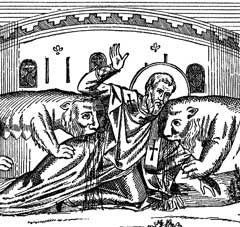
The authorities of Rome concluded that his martyrdom should take place on one of their great festivals, so that his punishment might be more public. Accordingly on the 29th of December, in the year 116 or 117, he was brought out into the amphitheatre and the lions were let loose upon him. They were not long in doing their work, but quickly devoured him, and left nothing but his bones. These the friends who came with him on his journey gathered up and carried back to Antioch.
And thus, as a martyr, Ignatius gave the highest testimony to his fidelity to the truth of that religion which he had preached and practiced. He gloried in his suf ferlngs. When he looked upon the chains that bound him, he called them his jewels and ornaments ; and he laid down his life with as much ease and comfort as another man would put off his clothes. And though the death he had to undergo was cruel and barbarous, yet the thought of it had no more effect upon his mind than the dashing of the ocean's waves upon the solid rock. These were the last words that he spoke, before he was led out to the lions : " Let the fire, and the cross, and the assaults of the wild beasts, and the breaking of bones, come upon me, so that I may be with Jesus my blessd Saviour. I would rather die for Christ than live and reign the sole monarch of the whole world."
Surely in the death of this "hero of the early Church" we have a splendid illustration of the triumph of faith.