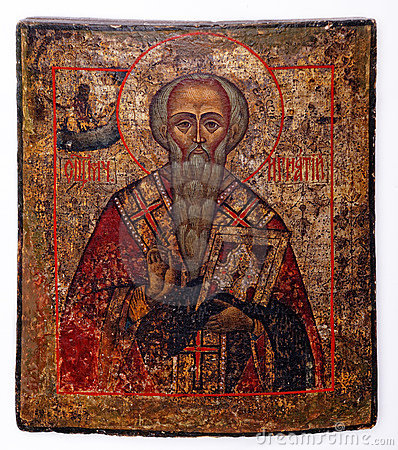
In the contemporary study of the Eucharist, certain theological questions present themselves with practical urgency, including the nature of the Eucharist, its status as a sacrament and sacrifice, the presence of the Lord in the bread and wine, and its place within the life of the Christian people. With this in mind, consulting early writings on the Eucharist can provide illumination for those seeking a life-centered theology of this Sacrament. The Church’s interpretation of the Scriptures is continually enriched by consultation with the sources living in the generations following the apostolic age. Ignatius of Antioch stands out to those seeking such perspectives on the Eucharist.
The Meaning and Importance of Unity
The letters of Ignatius, bishop of Antioch and martyr, offer a rich fund of teaching for the student of the Eucharist. Hurriedly composing six letters during two layovers on his journey to Rome, Ignatius justifies his self-assessment as a man set on unity? by weaving this theme into nearly everything he wrote. While unsystematic in form, this window into the early Christian mysticism of unity as it developed from, and centered upon, the Eucharist serves as a solid starting point for a re-appropriation of this sacrament within the context of our own age.
The Double Meaning of “Unity”
What is it, then, that Ignatius means by ‚unity,? and why is it so important to Christians? As to the first question, Ignatius seems to use the word both in the sense of a means and of an end. The visible and ordered harmony among the people, deacons, presbyters, and bishop is what he intends by its use in the instrumental sense. The clearest manifestation of this visible unity is obedience to the bishop, who is to be reverenced by Christians as the earthly representative of God the Father, and to the presbyters and deacons, who continue the ministry of the apostles and Jesus.
The end to which these means are directed is an invisible unity. Such harmony is the condition for worship acceptable to God, who rewards such worship with a place within his own life:
You must join this chorus, so that by being harmonious in unanimity and taking your pitch from God, you may sing in unison with one voice through Jesus Christ to the Father, in order that he may both hear you and acknowledge that you are members of his Son. It is, therefore, advantageous for you to be in perfect unity, in order that you may always have a share in God.
As this passage indicates, the participation in the life of God is the second, non-instrumental meaning of unity?: that for the sake of which Christians must order themselves individually and collectively. It is the invisible effect of the visible harmony. Exterior union is a gift of God that effects through membership in his Son the intimate fellowship with God that it signifies.
Thus, while it may be true that Ignatius sought to preserve the churches from Docetist or Judaizing influences through his insistence on visible harmony with the bishop, his ultimate meaning is something much more crucial. In fact, it is on account of his convictions about how it is that one shares in the salvation God offers through the Church that his attacks on heresy carry such weight. My subsequent consideration of the Eucharistic implications of Ignatius’ perspective seeks to make this clear.
For Ignatius, fellowship with the Father is not hypothetical speculation, but firmly founded upon the mission of his Son, born of David, who came forth from one Father and remained with the One and returned to the One?. Hence, the exterior unity of the church under the bishop has the character of the life shared by the Father and the Son; ultimately, they partake of one another in such a way as to blur the overly precise distinctions between means and ends introduced above. To put it another way, the exterior seeps into the heart, and the inner union strives for outward ratification in faith and love. This overlap between visible harmony and invisible fellowship with the life shared by the Father with the Son is what is meant by the term mystical.
Thus, while Ignatius may have had very practical reasons for preserving authority among the churches, his motivations sprang not merely from the exigencies of administration or the desire to preserve apostolic teaching from heretical distortions, but from the heart of a pastor rooted in the communication of the life and love of God.
Unity as the Goal of God’s Involvement in History
It is not hard to see the answer to the second question I posed: why was this so important to Ignatius? We have seen how subjection to the hierarchy in familial, religious terms is the mystical imitation of the bond between God and his Son. From here, we need not stretch far to reach the conclusion that the mystical unity of the Church in Christ is the very purpose the Father seeks to achieve through his Son. Ignatius marvelously encapsulates this mission in the beginning of his letter to the church in Smyrna:
I glorify Jesus Christ, the God who made you so wise, for I observed that you are established in an unshakable faith, having been nailed, as it were, to the cross of the Lord Jesus Christ in both body and spirit, and firmly established in love by the blood of Christ [who was] truly nailed in the flesh for us under Pontius Pilate and Herod the tetrarch (from its fruit we derive our existence, that is, from his divinely blessed suffering), in order that he might raise a banner for the ages through his resurrection for his saints and faithful people in the one body of his Church.
This mission is not a distribution of esoteric knowledge, but an invitation to suffer with Jesus on the cross—a past event that truly happened in his fleshly existence. Grounding in faith and love are the conditions for a fellowship with the Lord so close as to be regarded as nailed to his cross along with him. Faith is both an assent to factual content about Jesus as well as a personal act of trust and devotion to him. Love is the conduct that flows from faith as a river from its headwaters, and gives rise to all the Christian virtues. Because the Smyrnaean Christians have allowed the suffering of Christ to transform them in this life, the suffering that they share continues to have effects that are constitutive of the Church’s existence as a body, and the fraternal love they share is also the most sure indication that they are in fellowship with the Father as members of his Son.
Though Ignatius does not explicitly associate the unity of the Church with the proclamation of the Gospel to nonbelievers, his use of the image of the ‚banner? suggests that the witness of unity is not meant for Christians alone. The Church, then, is the assembly of those who hope to be raised to a life like Christ’s through union with him. With this context of the meaning and purpose of unity firmly established, we can profit from an exploration of what Ignatius has to say about the Eucharist.
Eucharist as the Lynchpin of the Father’s Ordered Plan
Ignatius mentions the Eucharist in one form or another in all six of his letters. This alone testifies to the great reverence in which he held it, as well as the need he felt to clarify its meaning for the Church. His reverence and directness intensifies in later letters, for he wrote in haste while at an unexpectedly brief stop in Troas. Ignatius thus seems to regard the Eucharist as among the most pivotal matters of which he is privileged to speak as a bishop and captive for Christ.
St. Ignatius and St. Paul
Ignatius seems to intend three meanings for the Greek eucharistia: the general practice of giving thanks to God in prayer, the celebration of the ritual, and the fleshly presence of the savior given to us as a gift by God. The first is used in the earlier letter to the Ephesians; the second and third make multiple appearances in the last two letters addressed to the churches in Philadelphia and Smyrna. However, it is in the earlier letter to the Ephesians that Ignatius formulates a startling synthesis between his theology of unity and the Eucharist by way of a ‚thesis statement? for a future letter he was unable to compose on account of his intervening death. The teaser runs like this:
Ignatius employs Pauline language with his use of the Greek word oikonomia. This word appears within the Lucan-Pauline tradition with a variety of meanings, but Ignatius uses it in a way that most resembles its use by Paul in the letter to the Ephesians to describe the Father’s orderly arrangement, dispensation, or providential plan. The Apostle to the Gentiles declares:In a second letter that I intend to write to you I will further explain to you the subject about which I have begun to speak, namely, the divine plan [oikonomia] with respect to the new man Jesus Christ, involving faith in him and love for him, his suffering and resurrection . . . All of you, individually and collectively, gather together in grace, by name, in one faith and one Jesus Christ, who physically was a descendant of David, who is Son of Man and Son of God, in order that you may obey the bishop and the council of presbyters with an undisturbed mind, breaking one bread, which is the medicine of immortality, the antidote we take in order not to die but to live forever in Jesus Christ.
He has made known to us in all wisdom and insight the mystery of his will, according to his purpose which he set forth in Christ as a plan [oikonomia] for the fullness of time, to unite all things in him, things in heaven and things on earth. (Eph. 1:10)
Note that for Paul, too, unity in Christ is the object of the Father’s purpose in the world — a point notable in itself, but more so in light of our investigations above. Hence, as Ignatius elaborates on just what this divine plan? entails, it must be situated within this context of mystical unity he has so tirelessly emphasized.
The Eucharistic Assembly
As if in answer to the unspoken question of what this new dispensation might be, Ignatius launches immediately into an exhortation to celebrate the Eucharist in union with the bishop and presbyters. He insists that participation in the one bread can only be done in common (gather together . . . breaking one bread); only in this common gathering are Christians healed of the disease of sin and death, that they may join God in life that has no end.
Ignatius indicates elsewhere why it is that such a gathering must be in obedience to the bishop and presbyters when he says, "Only that Eucharist which is under the authority of the bishop" is to be considered valid. In other words, the common assembly, harmoniously united under the bishop and with the presbyters and deacons, has as its purpose the Eucharistic meal; the meal is itself the banner of the resurrection? that Jesus has raised in order to gather all into the one body of his Church.
An Exhortation to Receptivity
To reinforce this point, we must once again return to the virtues of faith and love, which for Ignatius constitute and encompass the whole of life in Christ. Ignatius makes clear Eucharistic references when mentioning these virtues. When confronted with false teaching, the Trallians are to cling to Christ and the bishop, and thereby to arm themselves with gentleness and regain your strength in faith, which is the flesh of the Lord, and in love, which is the blood of Jesus Christ.
While some might interpret this text as undermining Eucharistic realism in favor of an analogical exhortation to ethical behavior, to do so misses the full meaning. The agape of which he speaks certainly includes love shared among Christians, but it also refers to the divine agape of which the Church is the object. Contemplating his own death, Ignatius longs not only for harmony in obedience to the hierarchy but that blood poured out on the cross, which is incorruptible love. This blood then, is not only something done, but something received — not from any man but from the man Christ Jesus, who suffered, died, and was raised in the flesh.
Take care, therefore, to participate in one Eucharist, for there is one flesh of our Lord Jesus Christ,
and one cup that leads to unity through his blood
Indeed, the Eucharist is of such importance to Christian faith that to reject it is to cut
oneself off from salvation. Ignatius rebukes the Docetist heretics that threaten the church of
Smyrna with their false teachings; as he does so, note how he uses the word eucharistia in two of
the senses noted above, namely: the celebration of the ritual, and the reality of his saving
presence.
They abstain from the Eucharist and from prayer, because they do not confess that the Eucharist
is the Flesh of our Savior Jesus Christ, which suffered for our sins and which, in his goodness, the
Father raised up those who deny the good gift of God perish in their contentiousness.
By refusing to believe the eternal Logos would sully itself by taking on flesh, the Docetists
rejected the Incarnation and any practices or beliefs that presumed its truth. In a reconstruction
of their logic, Ignatius perceives their abstention from the Eucharist as theologically consistent,
erroneous as it is. For it would be a denial of their Christology to partake of a fleshly Jesus in
the Eucharist that did not so exist before he was raised; yet, in the Eucharist, the Church
proclaims the risen Jesus in the flesh even after the resurrection?. The unity of the Church, the
Eucharist, and the saving mission of the incarnate Christ are all of a piece; rejection of any one
of them is a rejection of the whole ‚good gift of God? that comprises the total oikonomia.
Eucharistic fellowship, therefore, has a fundamental importance in this ordered
arrangement. This is so because it offers to believers the love poured out in the blood of the
cross; when received, this love overflows into fraternal charity, the practice of which the
Docetists were known to neglect. In gathering for the common prayer of the Eucharist, the
Church is rendered impermeable to disunity, for ‚the powers of Satan are overthrown and his
destructiveness is nullified by the unanimity of your faith.? Ignatius is clear: Docetists remain
in death as long as they do not partake in the bread of God. One can hardly read these words
without being reminded that ‚unless you eat the flesh of the Son of Man and drink his blood,
you have no life in you . . . .? (John 6:53)
Indeed, Ignatius repeatedly echoes the Gospel of John, a text with which Ignatius in all
likelihood was familiar. Continuing ahead in the Bread of Life discourse, the evangelist
describes what it means to eat this bread when he says,
He who eats my flesh and drinks my blood abides in me, and I in him. As the living Father sent
me, and I live because of the Father, so he who eats me will live because of me. (Jn. 6:56-7)
The intended audience of this gospel would have immediately recognized this discourse as an
allusion to the common meal shared by Christians in commemoration of the dying and rising of
the Lord. This audience would have understood Jesus as claiming that those who eat the bread
of life in the context of the communal assembly were not just expressing their sociological unity
with one another, but being drawn into life-giving union with Jesus and the Father who sent
him.
Ignatius beautifully encapsulates this Johannine teaching in his reference to the
Eucharist as the ‚medicine of immortality? and the antidote to death, and in so doing, the
whole thesis passage in question (quoted from the Letter to the Ephesians near the beginning of
Section II) draws together his themes of ecclesial unity the role of the bishop, and the
medicinal and eschatological effects of the Eucharist.? Reading these Eucharistic references in
the context of his mysticism of unity preserves us from any interpretation of this rite as
somehow magically raising one from the dead by its own power.
The way in which Ignatius approaches his own death also sheds light on the meaning of
the Eucharist in the early church. Apart from participation in the redemptive suffering of the
Lord, mystical union is not possible; so too, if there is real union, it will be with the dying and
rising Lord.
Let me be food for the wild beasts, through whom I can reach God. I am God’s wheat, and I am
being ground by the teeth of the wild beasts, so that I may prove to be pure bread . . . Then I will
truly be a disciple of Jesus Christ, when the world will no longer see my body.
Ignatius here seeks to imitate Jesus not only as he existed historically but in the very way he is
continually active in the world: the Eucharist. He identifies so strongly with Christ that his
deepest desire is to imitate Jesus’ own self-offering to the world as nourishment in the form of a
sacrificial meal: I am a humble sacrifice for you.? Here, we see the height of agape exemplified
in the act of faith-filled trust in the Lord that endures beyond every trial, even beyond death;
here, discrete acts of fraternal charity and the incorruptible love of God poured out on the cross
merge into a oneness in which each is indistinguishable from the other.
In this survey of the Eucharistic dimensions of the mysticism of unity in the letters of St.
Ignatius, the applicability of this early theology and practice to that of our own day is clear. We
have seen how ecclesial unity in the form of religious obedience to the bishop, presbyters, and
deacons is both a means to fellowship with God and its ultimate goal, for it requires a
harmonious and like-minded people in order to flourish and intensify. Faith is not a mere
intellectual assent, and love is more than just an ethical expression of one’s discipleship; these
are acts of personal trust and participation in the most efficacious display of the agape of God for
his Church.
Each of these dimensions of discipleship finds its culminating source and expression in
the common gathering at which the Eucharist is offered by the bishop in union with his council
of presbyters and deacons. Rejection of Eucharistic doctrine and fellowship is the rejection of
God’s whole saving plan as carried out by his incarnate Son, who offers his risen flesh to his
disciples in the Eucharist. Finally, the witness of Ignatius’ own death as the culmination of
Christian discipleship takes on a Eucharistic savor, thereby demonstrating the goal of every true
disciple as a total imitation of the self-offering love of his savior, through which the believer has
a share in God himself. There can be no doubt that the Eucharistic theology here presented as
the fruit of a mysticism of unity beckons the Church of today to a greater devotion and
appreciation for this good gift of God.?
Corwin, Virginia. St. Ignatius and Christianity in Antioch. New Haven: Yale University Press, 1960.Docetists, the Eucharist, and the Gospel of John
A Johannine Rebuke
Configured to the Eucharistic Jesus
The Mysticism of Unity in the Church Today
Works Cited:
Holmes, Michael W., ed., trans. The Apostolic Fathers in English. Grand Rapids: Baker Academic, 2006.
Johanny, Raymond. "Ignatius of Antioch." In The Eucharist of the Early Christians, ed. Willy Rordorf, trans. Matthew J.
O’Connell, 48-70. New York: Pueblo Publishing Company, 1978.
LaVerdiere, Eugene, Eucharist in the New Testament and the Early Church. Collegeville: Liturgical Press, 1996.
O’Connor, James T. The Hidden Manna. San Francisco: Ignatius Press, 1988.
Richardson, Cyril Charles. The Christianity of Ignatius of Antioch. New York: AMS Press, Inc., 1967.